
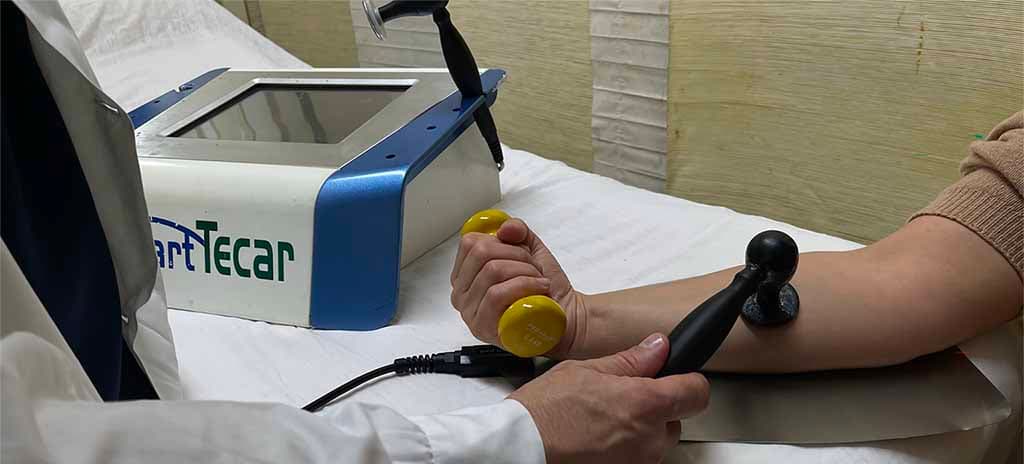
Have you heard about TECAR therapy but aren't quite sure what it is? You're not alone. Although the method has been widely used in physiotherapy for decades, many patients arrive at their appointment with only a vague idea of what is about to happen.
In this article we will explain in plain terms what TECAR is (also known as diathermy in physiotherapy), how it works in the body, which conditions it can help with, and what to expect during a session. Please note: this article provides general information and does not replace a personalised assessment by a licensed physiotherapist.
What Is TECAR Therapy?
TECAR (Transfer of Energy Capacitive and Resistive) is a form of therapeutic diathermy that uses radio frequencies to deliver electromagnetic energy deep into the body's tissues. In simple terms, it involves a controlled generation of heat within muscles, tendons, joints and ligaments — without any sensation of burning on the skin's surface.
It differs from older forms of diathermy (such as ultrasound or simple heat packs) because it acts at a greater tissue depth and in a far more controlled manner. There are two main modes:
- Capacitive mode: Targets soft tissues with a high water content, such as muscles and bursae.
- Resistive mode: Targets denser tissues, such as tendons, ligaments, cartilage and bone.
The therapist chooses which mode to use — or a combination of both — depending on the condition and the stage of treatment.
How Does It Work in the Body?
The electromagnetic energy produced by TECAR brings about two key effects in the tissues:
- Thermal effect: An increase in local temperature within the deeper tissues, which improves blood and lymphatic circulation, relaxes muscle spasms, and supports the body's natural healing process.
- Non-thermal (bioelectric) effect: Even at low intensities with no marked sensation of heat, TECAR can influence cellular metabolism, boost circulation and reduce inflammation.
The result is typically a reduction in pain, restoration of mobility, and faster healing — particularly when TECAR is combined with other physiotherapy techniques. The precise tissues affected and the extent of the effect depend on the parameters selected by the physiotherapist.
Which Conditions Is It Used For?
TECAR diathermy is used for a wide range of musculoskeletal and sports-related conditions. Some of the most common applications include:
- Low back pain and back pain: One of the most frequent reasons for using TECAR, particularly in chronic cases or following an acute episode.
- Neck pain and cervical syndrome: Helps to relax tight neck muscles and reduce pain.
- Tendinopathies and tendinitis: Including the Achilles tendon, rotator cuff, and epicondylitis.
- Joint sprains: Particularly ankle sprains in the sub-acute phase.
- Muscle strains and myalgia: Assists in the recovery of muscle fibres and reduction of pain.
- Shoulder and hip pain: Including shoulder periarthritis.
- Arthritis and degenerative conditions: In conditions such as knee osteoarthritis, TECAR can contribute to pain management and improved mobility.
- Post-surgical rehabilitation: Used following orthopaedic procedures to accelerate recovery.
Important: TECAR is not suitable for everyone. It is contraindicated in cases such as pregnancy, a cardiac pacemaker, active inflammation, or malignancy in the treatment area. The physiotherapist always assesses each patient individually before use.
Acute or Chronic Condition? When Is It Used?
A common question is: "Can I have TECAR immediately after an injury?" The answer depends on the phase.
- Acute phase (first 24–72 hours): At this stage it is typically used at low intensities and without a thermal effect, primarily to manage swelling and inflammation.
- Sub-acute phase: As the inflammation subsides, the intensity and duration can be increased to accelerate healing.
- Chronic phase: For chronic pain and degenerative conditions, TECAR is used at higher intensities for deeper penetration and longer-lasting results.
The treatment plan (intensity, duration, number of sessions) is always tailored to the individual by the physiotherapist.
What Does a Typical Session Look Like?
If you have never had TECAR before, it is natural to wonder exactly what happens. Here is a general overview:
- First, the physiotherapist assesses the area and determines the session parameters.
- A specialised handpiece (capacitive or resistive) is moved in circular motions over the area requiring treatment, usually with the aid of a conductive gel.
- You feel a pleasant, diffuse warmth within the tissue — quite different from the surface heat of a heat pack.
- A session typically lasts between 20 and 40 minutes, depending on the condition and the areas being treated.
- No special preparation is needed; simply wear comfortable clothing that allows access to the area.
Most patients report that the session is relaxing. Afterwards, you may notice a mild feeling of lightness or warmth that fades shortly after.
How Many Sessions Are Needed?
There is no universal answer, as it depends on the nature and chronicity of the condition, the patient's age and general health, and the overall treatment approach.
As a general guide:
- Acute conditions: Typically 4–8 sessions may be sufficient.
- Chronic conditions: More sessions are often required, spread over a number of weeks.
- TECAR is almost always combined with other techniques (exercise therapy, manual therapy, exercises) for better results.
If you live in Voula, Vouliagmeni, Vari, Glyfada or Alimos and find it difficult to travel, home physiotherapy allows treatments such as TECAR to be carried out at your own home, with no journey or waiting room.
TECAR in Combination with Other Treatments
TECAR is rarely used in isolation. In most cases it forms part of a comprehensive treatment plan that may include:
- Manual therapy: Mobilisation and manipulation techniques that complement the thermal action of TECAR on the joints and spine.
- Clinical Pilates: Strengthening and stabilisation exercises that reinforce the effects of TECAR over the long term.
- Exercise therapy and exercises: A personalised exercise programme to restore functional ability.
- Lymphatic drainage: In cases involving swelling, combined use can improve outcomes.
The combination is always chosen on the basis of each patient's condition and the goals of treatment.
What Are the Advantages Over Other Treatments?
TECAR has earned its place in modern physiotherapy for several reasons:
- Deep penetration: Reaches tissues that superficial treatments struggle to access.
- Non-invasive: No needles, no incisions, no recovery time after the session.
- Flexible application: Can be used for both acute and chronic conditions by adjusting the parameters.
- Well-tolerated and comfortable: The sensation of warmth is generally pleasant, with no discomfort.
- Compatible with other treatments: Does not preclude the concurrent use of other physiotherapy techniques.
Of course, no therapeutic tool is suitable for everyone and every condition. A proper assessment by a qualified professional remains the most important first step.
Where to Turn
If you are suffering from chronic or acute musculoskeletal pain and would like to find out whether TECAR therapy could help you, the next step is a personalised assessment.
Konstantinos Danalis, licensed Physiotherapist & Chiropractor, offers home physiotherapy in Voula, Vouliagmeni, Vari, Glyfada and Alimos. Assessment and treatment can take place in your own home, with no need to travel to a clinic.
Contact us to schedule a session and find out together whether TECAR or another therapeutic approach is right for your needs.