
What is a Tendon?
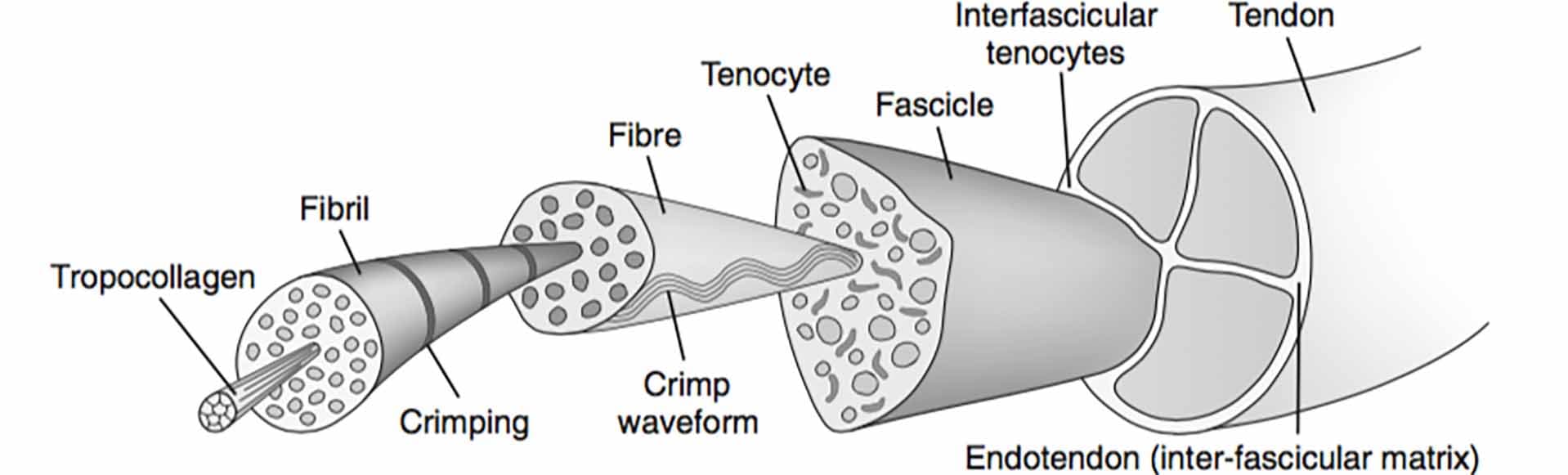
A muscle is made up of its central part — the belly — which contracts and produces movement at a joint, and its peripheral parts, which act like ropes and attach to a bone. These peripheral parts are the tendons. A tendon works both like a rope and like a stiff spring: it changes very little in length and is able to store energy. A tendon is made up of long collagen fibres wrapped in connective tissue — like small ropes — and together they form the larger structure: the tendon.
What is Tendinopathy and What are its Symptoms?
Tendinopathy is the broad term covering any condition of the tendon, whether chronic or acute, painful or pain-free. Tendinopathy occurs when the elastic limit of some collagen fibres within the tendon is exceeded, or their continuity is disrupted. The symptoms of Tendinopathy are:
• Reduced muscle strength
• Muscle atrophy in chronic cases
• Pain may be present, but it is not necessarily a feature in the advanced stages
Tendinopathy can be caused by:
• A sudden, sharp, heavy load that the tendon is not accustomed to bearing
• A small load applied repeatedly and continuously, causing cumulative strain
• A shear load — a force acting perpendicular to the tendon — that causes injury, either from a direct blow or from chronic overuse
What are the Stages of Tendinopathy?
Tendinopathy has 3 stages:
• Reactive Tendinopathy: This is the painful, initial stage of the condition, accompanied by thickening of the tendon at the site of injury.
• Tendon Disrepair: This is the intermediate stage, in which collagen fibres are regenerating but are not aligned with the tendon, which shows thickening. There is no pain at this stage, and with appropriate treatment it is possible to return to the previous stage.
• Degenerative Tendinopathy: This is the final stage, in which the collagen fibres can no longer be repaired and many have lost their continuity. A sudden heavy load carries a significant risk of tendon rupture. There is no pain at this stage.
Because the tendon is made up of bundles of collagen fibres that function like small individual tendons, they are not all affected at the same time — some fibres may be healthy whilst others may be at one of the three stages of Tendinopathy. This means that a single tendon can simultaneously be in all three stages.
What is Tendinitis?
The term Tendinitis is an older one, although it is still widely used. It describes the painful stage of Tendinopathy; however, with our current understanding we know that this stage may not involve inflammation — which is why anti-inflammatory medications do not always provide relief in these cases.
How is Tendinopathy Treated?
Tendinopathy is managed with Physiotherapy and advice to the patient regarding changes to their daily activities or training programme if they are an athlete. Treatment of the tendon requires:
• Unloading — resting the tendon. We provide guidance on the adjustments needed in daily life or training.
• Progressive reloading, using tailored and specialised exercises, both plyometric and slow-loading. Exercise dosage is crucial, and is matched to the stage of the condition, in order to manage pain.
• Muscle strengthening. Strengthening the muscle improves the torque applied at the joint, increases the tendon's load tolerance, and reduces its exposure to shear forces.
It is very important to address the pain in Tendinopathy, so that the patient is able to progress through the subsequent stages of treatment. The following approaches are used to manage pain:
Orthopaedic Manipulative Physiotherapist Mr Konstantinos Danalis applies a specialised exercise programme combined with electrotherapy and massage, with immediate results in pain reduction.
What Will Happen if I Don't Treat my Tendinopathy?
Tendinopathy that goes untreated becomes chronic. Symptoms typically recur over the years, and the tendon's load tolerance and muscle strength gradually decline. Over time, the risk of tendon rupture increases significantly.
Share this:
Call PhysioDanali today to consult with a Physiotherapist!
•
Woodley BL, Newsham-West RJ, Baxter GD. Chronic tendinopathy: effectiveness of eccentric exercise. Br J Sports Med. 2007 Apr;41(4):188-98; discussion 199. doi: 10.1136/bjsm.2006.029769. Epub 2006 Oct 24. PMID: 17062655; PMCID: PMC2658941.
•
Cook JL, Purdam CR. Is tendon pathology a continuum? A pathology model to explain the clinical presentation of load-induced tendinopathy. Br J Sports Med. 2009 Jun;43(6):409-16. doi: 10.1136/bjsm.2008.051193. Epub 2008 Sep 23. PMID: 18812414.
•
Khan KM, Cook JL, Maffulli N, Kannus P. Where is the pain coming from in tendinopathy? It may be biochemical, not only structural, in origin. Br J Sports Med. 2000 Apr;34(2):81-3. doi: 10.1136/bjsm.34.2.81. Erratum in: Br J Sports Med 2000 Aug;34(4):318. PMID: 10786860; PMCID: PMC1724184.
• www.physio-pedia.com