
Conditions and Treatment Options
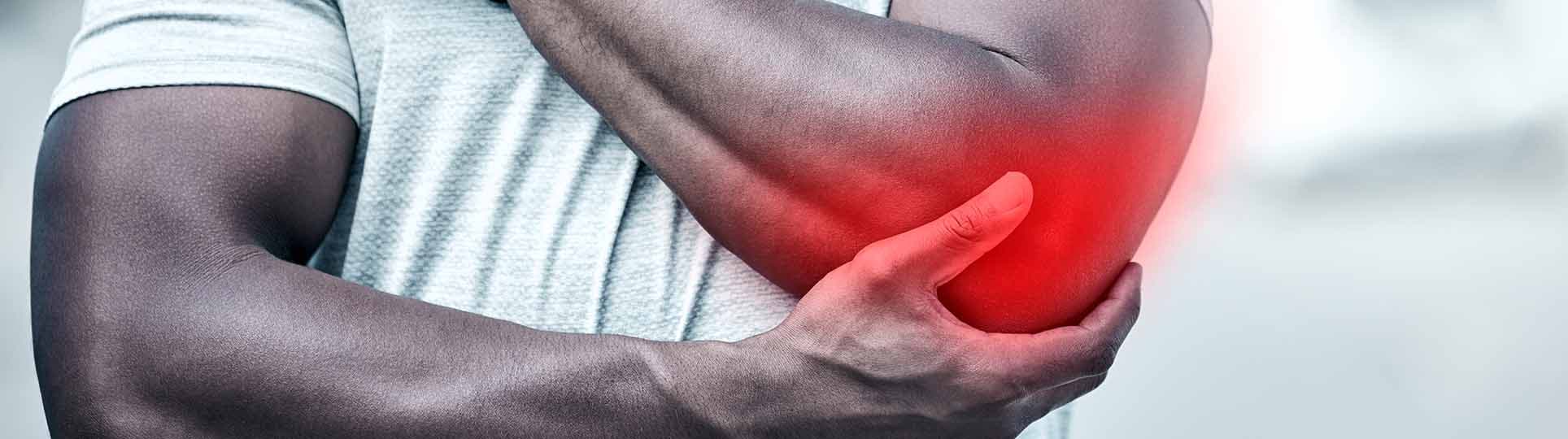
Elbow pain can arise from various tissues in the human body — muscle bellies, tendons, bursae, ligaments, bones, cartilage, and nerves. It may, however, also stem from more than one cause, meaning a patient may have co-existing conditions. Physiotherapist Konstantinos Danalis assesses patients by applying international clinical guidelines and identifies the tissues most likely responsible for the pain, so that targeted treatment can be provided.
What Are Tennis Elbow and Golfer's Elbow?
These conditions are also known as epicondylitis. Lateral epicondylitis is the term for tennis elbow and medial epicondylitis for golfer's elbow, precisely because they occur frequently in athletes who participate in these sports. They present on the outer and inner side of the elbow respectively, and involve tendinopathy and possible inflammation in the corresponding areas.
What Causes Elbow Pain?
The most common cause of elbow pain is overuse through repetitive movement of the elbow under significant load. It frequently affects athletes, as well as people whose activities require continuous use of either the elbow or the wrist.
How Can Elbow Pain Be Relieved?
When elbow pain appears, the immediate steps to take are:
• Rest the arm and avoid the activity that is causing the pain
• Apply ice to the elbow, at the painful area, for 15–20 minutes, 2–3 times a day (the ice should be wrapped in a towel)
• Compress the area with a bandage
• Gentle stretches of the shoulder, elbow, wrist, and fingers help maintain flexibility in the arm
What Are the Symptoms of Elbow Pain?
Elbow pain may be localised, appearing on the outer side — tennis elbow — or on the inner side — golfer's elbow — and can be reproduced by pressing on the corresponding bony prominences on the inner and outer aspects of the elbow. The pain usually appears in the right arm — in left-handed individuals, in the left arm — but in particular cases it may appear in both arms simultaneously. The pain can radiate towards the wrist or towards the shoulder and neck. It may feel like tenderness in the area during elbow movement, numbness, and restricted movement.
Movements that may trigger the pain include lifting weights, making a fist or gripping an object, opening a door, and even a handshake.
When Do I Need to See a Physiotherapist?
• When the pain does not settle after several days, despite carrying out the initial steps described above
• The pain is very severe, and there is swelling and bruising
• The pain is present even without moving the arm
• Daily activities are hindered by an inability to bend or straighten the elbow
What Will Happen If I Do Nothing About the Elbow Pain?
The pain may ease after a period of time, but it will return later, more intensely and causing significant restriction in the movement of the arm.
What Is the Best Treatment for Elbow Pain?
If the pain you have is mild, carrying out the immediate steps mentioned above makes it very likely to settle quickly. If, however, it does not settle, or is more than mild, physiotherapy is required to reduce the pain, restore range of movement, and rebuild strength in the arm. Physiotherapist Konstantinos Danalis applies:
How Long Does Elbow Pain Last?
Elbow pain typically lasts around 2 weeks if nothing is done about it. In more complex cases, however, the pain may persist for several weeks.
How Can I Prevent Elbow Pain?
To avoid elbow pain you should:
• Stop the activity as soon as you feel pain
• Avoid carrying heavy objects
• Perform appropriate stretches for the arm
• Improve the ergonomics of your workstation
Will Wearing an Elbow Brace Help?
Although the use of an elbow brace was previously recommended to reduce pain and support the elbow during sport or activity, more recent studies show that it does not in fact help reduce pain, so you do not need to wear one. Should you choose to wear one, you should be aware that prolonged use over several days may lead to muscle atrophy and is therefore not advisable.
What Are the Most Common Causes of Elbow Pain? Differential Diagnosis.
• Bursitis
• Sprain
• Muscle strain
• Tendinopathy
• Golfer's Elbow (medial epicondylalgia)
• Tennis Elbow (lateral epicondylalgia)
• Osteoarthritis
• Ulnar neuritis
Call PhysioDanali today to consult with a Physiotherapist!
• Lucado AM, Day JM, Vincent JI, et al. Lateral Elbow Pain and Muscle Function Impairments. J Orthop Sports Phys Ther. 2022;52(12):CPG1-CPG111. doi:10.2519/jospt.2022.0302
• Landesa-Piñeiro L, Leirós-Rodríguez R. Physiotherapy treatment of lateral epicondylitis: A systematic review. J Back Musculoskelet Rehabil. 2022;35(3):463-477. doi:10.3233/BMR-210053