
About Knee Pain
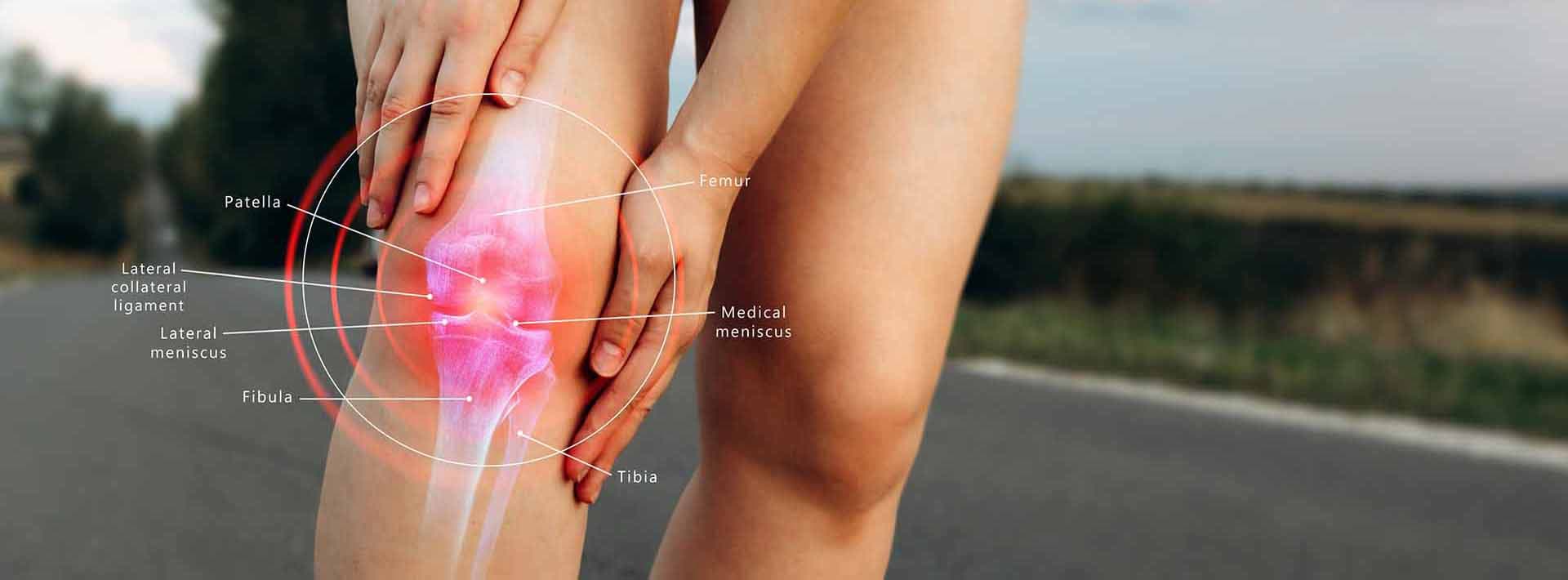
Knee pain is not always a straightforward matter. It may originate from any one of the many structures that make up the knee, which include:
• Joints and articular cartilage
• Muscles
• Tendons
• Ligaments
• Bursae
• Joint capsules
• Bones
Persistent and severe pain often originates from two or more of the above structures, or from an injury.
Characteristics of Knee Pain
Knee pain can range from mild discomfort during specific movements to unbearable pain even at rest. For assessment purposes, it is important to determine whether the pain occurs during movement, which particular movements provoke it, how long it takes to settle, or whether it persists at rest and for how long. It is also important to establish whether there is any night pain and how long it lasts. Knee pain may have the following characteristics:
• Sharp
• Knife-like
• Throbbing
• Burning
• Electric shock-like
• Superficial
• Deep
• Mild
• Dull
• Constant
• Intermittent
How to Relieve Knee Pain?
When knee pain appears, the immediate steps to take are:
• Rest the leg and avoid the activity that causes the pain
• Rest with the leg elevated on a chair or a pillow
• Apply ice to the knee, over the painful area, for 15–20 minutes, 2–3 times per day (the ice should be wrapped in a towel)
• Gentle stretches of the hip, knee, and foot help maintain the flexibility of the leg
Differential Assessment for Knee Pain
Assessment by a Physiotherapist is essential to identify the affected structures and to rule out, or confirm, the coexistence of other conditions that present with similar symptoms, such as:
• Patellar Tendinopathy
• Patellofemoral Syndrome
• Anterior Cruciate Ligament Rupture
• Medial or Lateral Collateral Ligament Rupture
• Posterolateral Corner Injury
• Posteromedial Corner Injury
• Meniscus Tear
Assessment by Orthopaedic Manipulative Physiotherapist Mr Konstantinos Danalis is carried out through a thorough case history, clinical tests, and a trial treatment that follows.
How Does Physiotherapy Help with Knee Pain?
The priority is to reduce pain, which in some patients can be extremely severe. This is achieved through a combination of treatment options, such as specialist massage and the application of electrotherapy, which will reduce pain in every case. The knee is then mobilised using specialist exercises. Gradually, as range of movement increases, strengthening, balance, and proprioception exercises are introduced. The interventions used include:
• Stretching and flexibility exercises to increase elasticity
• Dynamic stability and strengthening
• Orthopaedic Manipulative Physiotherapy to reduce pain and improve flexibility
• Electrophysical agents such as diathermy, cryotherapy, and electrotherapy, to reduce pain and inflammation
• TECAR for deep tissue heating and to accelerate recovery
Schedule Your Appointment
Athanasia A.
Mr Danalis is a truly professional practitioner who gives the necessary attention to the patient and their problem. Most importantly, the quality and effectiveness of the treatment is outstanding — creative and above all results-driven. I recommend him wholeheartedly.
Erifyli S.
Mr Danalis knows his field very well and devotes a great deal of personal attention to his patients! He has a positive attitude and has helped me enormously!! I trust him completely and recommend him without reservation.
Giota S.
He knows his subject very well, spent a great deal of time on my problem, and truly earned my trust! I will definitely recommend him!
How Can I Prevent Knee Pain?
To prevent knee pain in chronic conditions, a monthly programme is required, which includes:
• Orthopaedic manipulative massage
• A structured exercise programme
More advice on prevention and self-management can be found at the links below:
• Recomendations for Patients by American Physical Therapy Association
• Recomendations for Patients by American Physical Therapy Association
• Recomendations for Patients by American Physical Therapy Association
• Recomendations for Patients by American Physical Therapy Association
• Recomendations for Patients by American Physical Therapy Association
• Recomendations for Patients by American Physical Therapy Association
• Recomendations for Patients by American Physical Therapy Association
What Is the Cost of Treatment?
The cost of treatment is not high. Typically, 6 sessions are required, during which the treatment programme is adjusted each time to suit the patient's current condition. Once symptoms have settled, a structured exercise programme is introduced to prevent any recurrence. The programme is provided to the patient electronically so they can follow it independently, with the option of online supervision at a low cost. The patient has the ongoing support and communication they need with the Physiotherapist in order to address any difficulties.
If you have Knee Pain, call PhysioDanali today for specialist advice from your Physiotherapist!
• Tsokanos A, Livieratou E, Billis E, Tsekoura M, Tatsios P, Tsepis E, Fousekis K. The Efficacy of Manual Therapy in Patients with Knee Osteoarthritis: A Systematic Review. Medicina (Kaunas). 2021 Jul 7;57(7):696. doi: 10.3390/medicina57070696. PMID: 34356977; PMCID: PMC8304320.
• Runge N, Aina A, May S. The Benefits of Adding Manual Therapy to Exercise Therapy for Improving Pain and Function in Patients With Knee or Hip Osteoarthritis: A Systematic Review With Meta-analysis. J Orthop Sports Phys Ther. 2022 Oct;52(10):675-A13. doi: 10.2519/jospt.2022.11062. Epub 2022 Jul 26. PMID: 35881705.
• Skou ST, Pedersen BK, Abbott JH, Patterson B, Barton C. Physical Activity and Exercise Therapy Benefit More Than Just Symptoms and Impairments in People With Hip and Knee Osteoarthritis. J Orthop Sports Phys Ther. 2018 Jun;48(6):439-447. doi: 10.2519/jospt.2018.7877. Epub 2018 Apr 18. PMID: 29669488.
•
Logerstedt DS, Scalzitti D, Risberg MA, Engebretsen L, Webster KE, Feller J, Snyder-Mackler L, Axe MJ, McDonough CM. Knee Stability and Movement Coordination Impairments: Knee Ligament Sprain Revision 2017. J Orthop Sports Phys Ther. 2017 Nov;47(11):A1-A47. doi: 10.2519/jospt.2017.0303. PMID: 29089004.
•
Logerstedt DS, Snyder-Mackler L, Ritter RC, Axe MJ, Godges JJ; Orthopaedic Section of the American Physical Therapist Association. Knee stability and movement coordination impairments: knee ligament sprain. J Orthop Sports Phys Ther. 2010 Apr;40(4):A1-A37. doi: 10.2519/jospt.2010.0303. PMID: 20357420; PMCID: PMC3158982.
• www.physio-pedia.com - LCL injury
• www.physio-pedia.com - MCL injury